
Every hospital wants a robotic surgery program as a symbol of clinical excellence, but far fewer are willing to present the board with the true utilisation-adjusted financial model behind the investment. The reality is often less impressive than the marketing narrative.
A robotic surgery platform demands a significant upfront capital investment, followed by recurring annual service and consumable costs irrespective of procedure volume. These fixed costs continue whether the system is used sparingly or extensively, making actual utilisation, not projected demand, the single biggest determinant of return on investment.
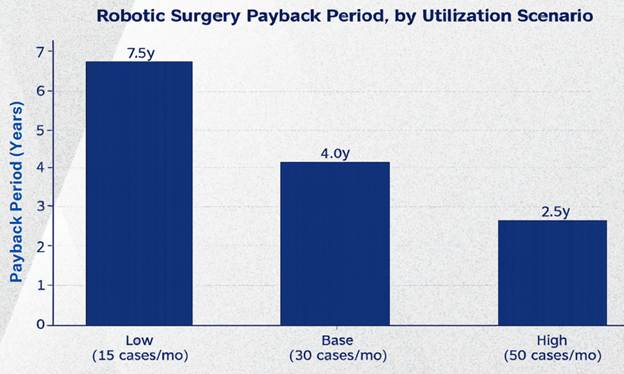
𝗜𝗻𝗳𝗼𝗴𝗿𝗮𝗽𝗵𝗶𝗰 𝗜𝗻𝘀𝗶𝗴𝗵𝘁
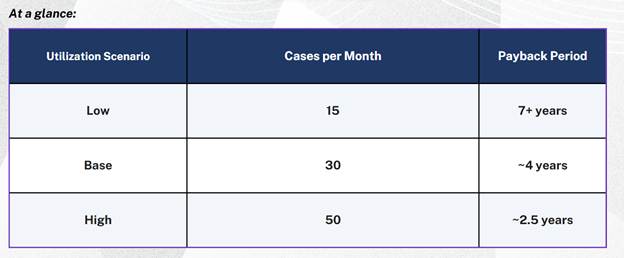
Robotic surgery is a utilization-driven investment. As procedure volumes increase, the payback period declines significantly—from 7.5 years at 15 cases/month to 4.0 years at 30 cases/month, and just 2.5 years at 50 cases/month.
A robot performing only a few procedures each week while incurring full maintenance costs is not a financial success. The business case should therefore be built on three realistic assumptions:
• First, estimate achievable monthly case volume based on surgeons who are genuinely committed to using the platform and supported by an established referral pipeline, not optimistic expectations that demand will grow simply because the hospital owns a robot.
• Second, assess the actual price premium patients or insurers are willing to pay for robotic-assisted surgery over conventional procedures. In many markets, this premium is narrower than anticipated due to increasing price awareness.
• Third, calculate the true consumables and service cost per procedure, which increases with case volume and materially impacts profitability.
Many robotic programs generate value beyond direct procedural economics. They help recruit skilled surgeons, strengthen the hospital’s market positioning, and attract patients who subsequently generate revenue across other specialities. These halo benefits are legitimate but should be measured separately rather than used to justify weak standalone economics.
Boards should clearly distinguish between two investment objectives: whether the robotic program is expected to be directly EBITDA accretive through utilisation and pricing, or whether it is a strategic investment in recruitment and market positioning supported by the broader hospital P&L. Both approaches are valid, provided the choice is explicit from the outset.
Before approving any robotic surgery capex proposal, management should require three disciplines:
• A utilisation sensitivity analysis showing the breakeven point across multiple case-volume scenarios.
• A named list of committed surgeons with realistic individual procedure estimates.
• A separate projection of expected halo revenue from adjacent specialities, along with a framework to measure and monitor it.
Finally, hospitals should revisit the original business case 18–24 months after installation by comparing actual utilisation, pricing premiums, and consumable costs against projections, and report these variances honestly to the board. Without disciplined post-investment reviews, overly optimistic assumptions tend to be repeated in future capital proposals.
Robotic surgery becomes a sound investment only when approval is based on a realistic utilisation-adjusted financial model reflecting the hospital’s actual surgeon pipeline and market pricing power, not on the strength of the brochure alone.
𝗖𝗼𝗻𝗰𝗹𝘂𝘀𝗶𝗼𝗻
Robotic surgery can be clinically transformative and strategically valuable — but rarely on the numbers alone. The honest board decision isn’t “should we buy it,” but “are we buying an EBITDA driver or a positioning bet,” and pricing that choice correctly, upfront, is what separates disciplined capital allocation from an expensive brochure. — 𝗠𝗿 𝗣𝗿𝗮𝗵𝗹𝗮𝗱 𝗜𝗻𝗮𝗻𝗶 – 𝗚𝗹𝗼𝗯𝗮𝗹 𝗛𝗲𝗮𝗹𝘁𝗵𝗰𝗮𝗿𝗲 𝗙𝗶𝗻𝗮𝗻𝗰𝗲 𝗟𝗲𝗮𝗱𝗲𝗿 | 𝗛𝗲𝗮𝗹𝘁𝗵𝗰𝗮𝗿𝗲 𝗘𝗰𝗼𝗻𝗼𝗺𝗶𝘀𝘁 I 𝗛𝗼𝘀𝗽𝗶𝘁𝗮𝗹 𝗚𝗿𝗼𝘄𝘁𝗵 & 𝗖𝗮𝗽𝗶𝘁𝗮𝗹 𝗦𝘁𝗿𝗮𝘁𝗲𝗴𝗶𝘀𝘁